Scale & Strategy
together with
This is Scale & Strategy – the newsletter that makes you the MVP of every business conversation.
Here’s what we’ve got for you today:
- OpenAI is asking for more AI oversight than the White House
- Scorsese just gave AI one of its biggest Hollywood endorsements
OpenAI is asking for more AI oversight than the White House...
For an industry that usually spends its time arguing against regulation, OpenAI just took a surprisingly different position.
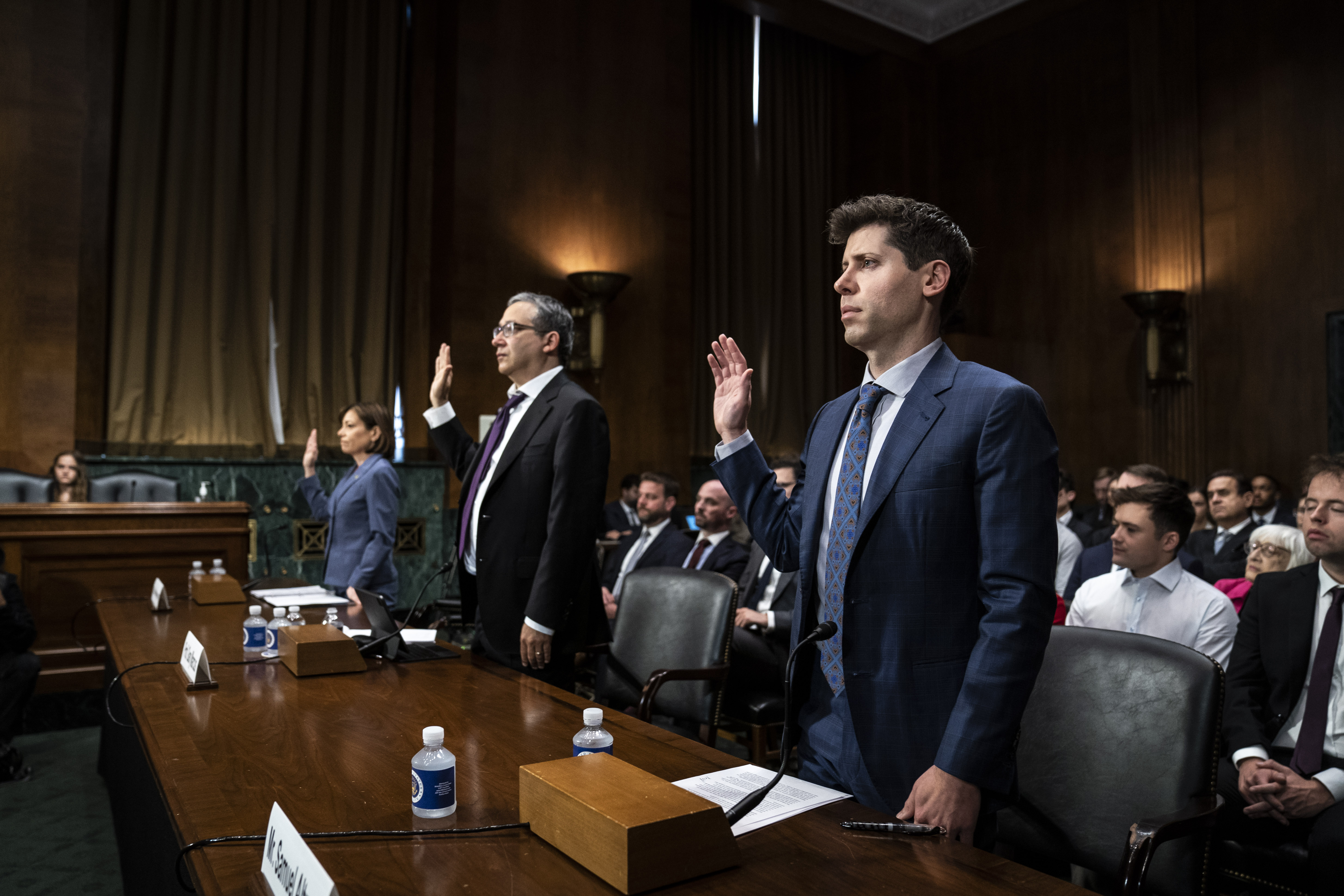
Following the Trump administration's new executive order on frontier AI models, OpenAI released a policy proposal that would impose stricter oversight than the government is currently pursuing.
The company argues that policymakers need a clearer view into how advanced AI capabilities are evolving and wants formal institutions responsible for evaluating frontier systems before they reach the public.
The biggest disagreement comes down to two questions: who runs the reviews, and whether companies should have to participate at all.
Under the White House executive order, certain frontier models can be voluntarily submitted for a 30-day security review before release. Oversight would sit largely within the national security apparatus, including the NSA.
OpenAI is proposing something different.
The company wants evaluations handled by civilian institutions, specifically the Center for AI Standards and Innovation (CAISI) under NIST and the Department of Commerce. OpenAI also wants those evaluations to be mandatory rather than optional.
That creates an interesting contrast.
On one hand, CEO Sam Altman publicly praised the executive order, saying it strikes the right balance between maintaining American leadership and addressing safety concerns.
On the other hand, OpenAI's own proposal pushes for a more formal review framework with stronger requirements than the administration ultimately adopted.
OpenAI isn't alone in supporting the executive order.
Anthropic, Amazon, and IBM have all publicly welcomed the lighter-touch framework. For the major AI labs, the final version represents a far more favorable outcome than some of the earlier proposals that circulated in Washington.
A mandatory 90-day review process would have been viewed as a direct drag on product releases. A voluntary 30-day framework is considerably easier to support.
The politics here are arguably more interesting than the policy.
Public trust in AI remains fragile, and most frontier labs understand that. Every major company in the space is trying to convince policymakers, regulators, customers, and the public that powerful AI can be developed responsibly.
Supporting some form of oversight helps reinforce that message.
OpenAI's proposal goes a step further. By advocating for stronger reviews than the government currently requires, the company positions itself as a lab willing to accept more scrutiny rather than less.
There are practical reasons for that stance as well.
OpenAI already has substantial safety infrastructure, evaluation teams, and deployment processes. Larger incumbents are often better positioned to absorb compliance requirements than smaller competitors. Regulatory frameworks can increase trust, but they can also raise the barrier to entry.
Whether that is the primary motivation is impossible to know from the outside.
What's clear is that OpenAI sees value in formalizing frontier model evaluations before someone else does it for them.
The broader takeaway is that the debate around AI regulation is evolving. The argument is no longer centered on whether oversight should exist. The fight is increasingly about who controls it, how much of it there should be, and which institutions get to decide what qualifies as safe enough to release.
That discussion is only getting started.
Improve your Google Ads performance—work 1:1 with an ex-Googler with 18 years of proven results
Most Google Ads agencies pass accounts to junior staff. Lighthouse Growth Consulting doesn’t.
Every campaign is built and managed directly by ex-Googler and founder Mike Kowieski, who helped build the very ad products businesses rely on today and has overseen more than $1B in ad spend.
With Lighthouse, it’s 1:1. There are no handoffs, no layers of account managers, and no wasted budget: just senior-level strategy and hands-on execution from day one.
Businesses partner with Lighthouse to:
- Eliminate wasted budget on unprofitable clicks.
- Stabilize unpredictable performance.
- Build campaigns that scale profitably over the long term.
Because the founder runs every account personally, Lighthouse only takes on a limited number of new clients each quarter.
Scorsese just gave AI one of its biggest Hollywood endorsements
The AI debate in Hollywood has a new participant, and it's hard to find one with more credibility than Martin Scorsese.
The legendary director is now working with Black Forest Labs as an advisor and says he's actively using the company's FLUX image-generation technology during pre-production.
His use case is refreshingly practical.
Scorsese isn't talking about replacing actors, generating entire movies, or handing creative control to algorithms. He's using AI to create storyboards and visual references so he can communicate ideas to his team faster and more clearly.
For filmmakers, that's a real bottleneck. Translating what's in your head into something hundreds of people can execute is often harder than coming up with the idea itself.
According to Scorsese, AI helps close that gap.
He compared the technology to other tools he has adopted throughout his career, including the 3D filmmaking techniques used in Hugo and the de-aging technology behind The Irishman. In his view, AI belongs in the same category: another production tool that can help creators work faster without sacrificing quality.
That perspective won't convince everyone.
Critics argue that AI-generated storyboards could reduce demand for storyboard artists and concept designers. Others remain concerned about how image models are trained and whether creative work has been used without permission.
Those concerns aren't going away anytime soon.
What's interesting is who is making the case for AI.
Scorsese has spent decades defending filmmaking as an art form. He's one of the loudest critics of creative shortcuts, franchise homogenization, and the industrialization of storytelling. He's about as far from a Silicon Valley hype merchant as you can get.
Which makes his endorsement harder to dismiss.
The broader reality is that Hollywood's AI debate is becoming less about whether creators will use AI and more about where they choose to use it.
Pre-production is emerging as one of the clearest examples. Storyboards, concept art, shot planning, visual exploration, and production design all involve generating large volumes of ideas before a single frame is filmed. AI is naturally useful there because speed matters and iteration matters.
The final creative decisions still belong to humans.
At least for now.
Black Forest Labs released footage showing Scorsese using the platform, making him one of the highest-profile filmmakers to publicly embrace AI tools in the creative process.
That's a meaningful signal.
Hollywood remains deeply divided on AI, but every time a respected director, writer, or producer adopts these tools, the conversation shifts a little further away from "whether" and a little closer to "how."
And if there's one lesson from film history, it's that new production technology tends to follow the same pattern. First it's dismissed. Then it's controversial. Then it's normal.
The interesting question isn't whether AI will become part of filmmaking.
That answer is already obvious.
The real fight is over which parts of the creative process remain distinctly human once the tools become good enough to help with almost everything else.
Was this email forwarded to you?
That’s it for today and as always It would mean the world to us if you help us grow and share this newsletter with other operators.
Our mission is to help as many business operators as possible, and we would love for you to help us with that mission!