Scale & Strategy
together with
This is Scale & Strategy, the daily newsletter that's your lighthouse in a storm of noise.
Here’s what we’ve got for you today:
- NVIDIA is now selling the entire AI stack.
- Most B2B marketers aren't using AI. They're dabbling.
- Anthropic is one funding round away from the trillion-dollar club
Nvidia isn't selling chips anymore. It's selling the entire AI stack.
For years, Nvidia was viewed as the company that happened to make the GPUs everyone needed for AI.
That framing is officially obsolete.
At Computex, Nvidia made it clear that it no longer wants to be the best component supplier in the AI ecosystem. It wants to own as much of the ecosystem itself as possible.
The announcements stretched from CPUs and data center operating systems to robotics models, AI factory software, local supercomputers, and next-generation infrastructure. Viewed individually, they look like product launches. Viewed together, they look like a company trying to become the default platform layer for the AI economy.
The most important announcement may have been the least obvious one: Vera.
Nvidia unveiled its new Vera CPU and positioned it specifically around agentic AI workloads. Not databases. Not spreadsheets. Not traditional enterprise software. Agents.
According to Nvidia, Vera is designed for tasks like tool use, code generation, reasoning, and data processing, delivering up to 1.8x better performance than traditional x86 CPUs on those workloads.
That alone would be notable. The more important signal is who has already signed up: OpenAI, Anthropic, xAI, CoreWeave, Lambda, Dell Technologies, Hewlett Packard Enterprise, and Lenovo.
Jensen Huang's thesis is straightforward: if AI agents become one of the largest consumers of compute, then the hardware stack should be designed around agents from the ground up.
Whether that prediction is right matters less than the fact that Nvidia is already building for it.
The company also launched DSX, a software platform for designing and operating AI factories. One component, DSX MaxLPS, claims to increase GPU density by 40% within the same power envelope through better cooling and power optimization. Another, DSX OS, is being positioned as an open operating system layer for AI factories.
That term, "AI factory," shows up constantly in Nvidia presentations because it's becoming the company's preferred framing for data centers. And honestly, it's not entirely marketing fluff. Modern AI facilities increasingly look less like traditional computing infrastructure and more like industrial production systems optimized around one output: intelligence.
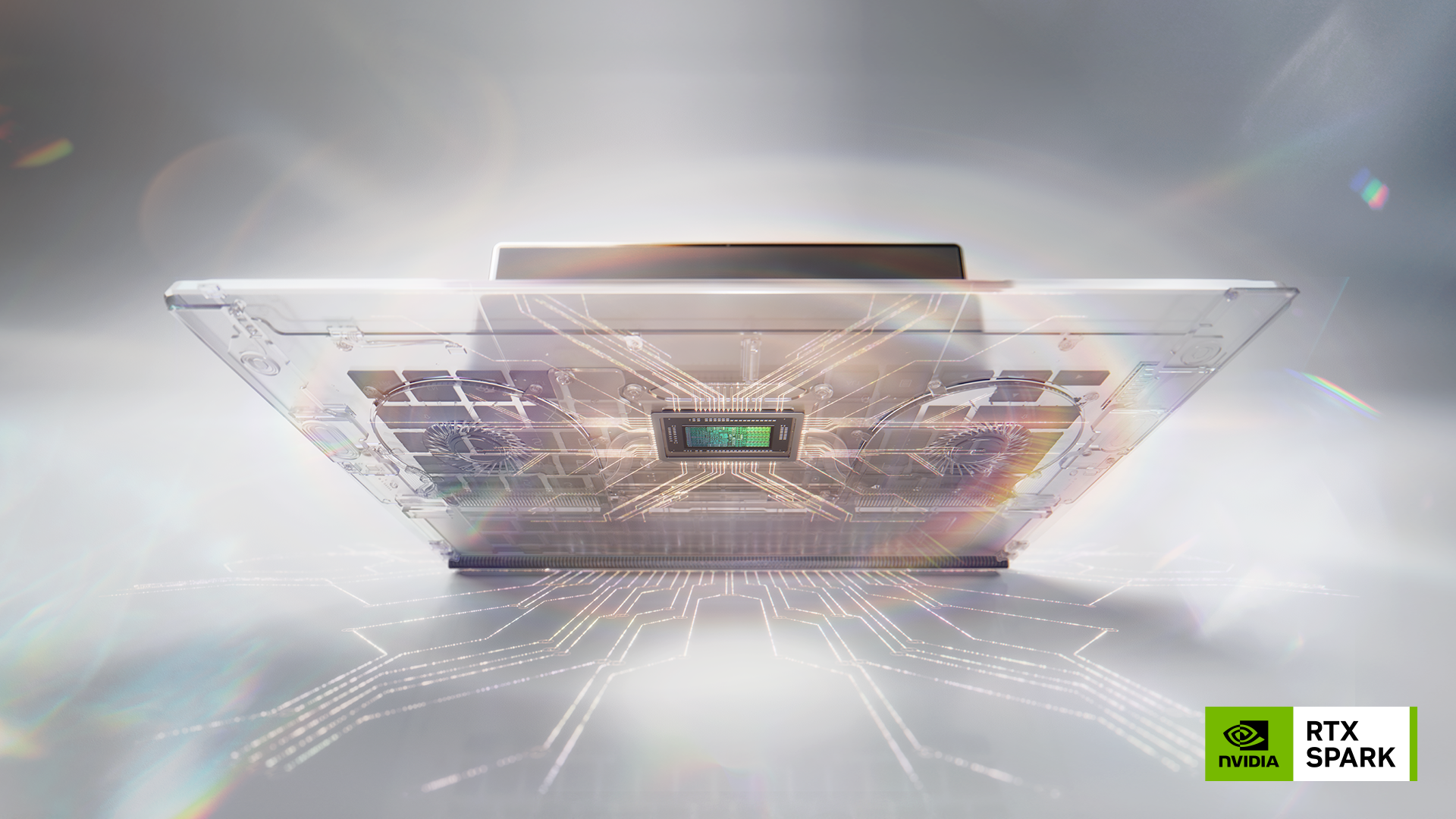
Nvidia also unveiled DGX Station for Windows, capable of running models with up to 1 trillion parameters locally. That's aimed squarely at researchers, developers, and enterprises that don't want every workload running through someone else's cloud.
Then there was the robotics push.
The company launched Cosmos 3, a multimodal world model designed for physical AI systems, alongside Alpamayo 2 Super for autonomous vehicles and H2 Plus, an open humanoid robot reference design combining hardware, software, and onboard compute.
Most people will focus on the humanoid robot headlines because humans have a near-religious attraction to robots. The more interesting part is Nvidia steadily assembling the infrastructure layer underneath physical AI before the market fully arrives.
Finally, Nvidia announced that Vera Rubin, its next-generation infrastructure platform combining CPUs, GPUs, networking, storage, and security, is now ramping into full production across 350 factories in 30 countries. Nvidia claims it delivers 10x the agent throughput of the previous Grace Blackwell generation.
The broader pattern is impossible to miss.
Every major announcement extends Nvidia's reach further beyond GPUs.
Five years ago, Nvidia sold accelerators.
Today it sells CPUs, networking, software platforms, robotics models, data center operating systems, supercomputers, and end-to-end AI infrastructure.
That's not an accident.
The company's biggest strategic risk isn't losing the GPU market tomorrow. It's a future where CUDA's dominance slowly erodes, models become more portable, and AI infrastructure becomes more commoditized. If that happens, Nvidia needs more than great chips.
It needs platform lock-in.
Computex wasn't really a hardware event. It was Nvidia showing what comes after being the GPU king. The answer appears to be becoming the operating system for AI itself.
Risk and regulations are ramping up, and customers expect proof of security just to do business. That’s why Vanta is a game changer.
Vanta automates your compliance and security processes in one AI-powered platform.
Whether you’re prepping for SOC 2, or running an enterprise GRC program, Vanta keeps you secure and your deals moving.
Companies like Ramp and Writer spend 82% less time on audits with Vanta. Faster compliance—and more time for growth.
Check out the on-demand demo to learn more. – trusted by top startups like Cursor, Linear, and Replit.
Most B2B marketers aren't using AI. They're dabbling.
The biggest gap in AI adoption isn't between companies using AI and companies ignoring it.
It's between teams treating AI as infrastructure and teams treating it like a slightly better autocomplete tool.
A recent analysis from Tarek Reslan combined survey data, behavioral research, and Reddit sentiment to see how B2B marketers are actually using AI today. The headline finding wasn't surprising: 75% of marketers are using AI for content production, including emails, landing pages, social posts, ads, and other creative work.
What was interesting is how differently the top performers approach the same tools.
The average marketer is still running a simple workflow: paste brief, generate draft, edit draft, repeat.
The stronger teams are building systems.
They're creating persistent brand context, custom GPTs, reusable prompts, review layers, internal knowledge bases, and workflows that improve every time the organization uses them. Instead of generating content one asset at a time, they're building infrastructure that compounds.
That's a very different game.
The next frontier appears to be agents.
When marketers were asked which AI skill they'd most like to master overnight, 42% chose building AI agents, making it the single most requested capability in the survey.
That makes sense.
Content generation is useful, but it's largely a productivity tool. Agents are different because they can execute workflows across multiple steps without constant supervision.
A content assistant writes a blog post.
An agent researches competitors, pulls market data, drafts the post, formats it, schedules distribution, monitors performance, and generates follow-up recommendations.
One is a tool. The other starts looking suspiciously like a teammate.
The demand reflects a broader shift happening across knowledge work. People are becoming less interested in AI that helps them work faster and more interested in AI that can own entire chunks of work.
Beyond agents, 24% of respondents said data analysis was the AI skill they most wanted to improve, while 18% pointed to brand voice consistency.
That last one remains painfully unresolved.
Most AI-generated marketing content is still easy to spot. Not because it's terrible, but because it often sounds like it was written by a committee of productivity influencers trapped inside a SaaS onboarding flow. If the internet survives another five years of "actually," "seamless," "unlock," and "bridge the gap," it'll be a miracle.
The most revealing finding may have been what's stopping people.
It isn't budget.
It isn't company resistance.
It isn't a lack of interest.
The biggest barrier was time.
About 43% of respondents said they simply don't have enough time to properly learn these tools. Another 24% said they aren't sure which skills are worth investing in at all.
That's an important distinction because it suggests most marketers aren't pushing back against AI. They're overwhelmed by the volume of new capabilities appearing every month and struggling to separate durable skills from temporary hype cycles.
Which is understandable. The industry has somehow managed to create a world where every LinkedIn post promises that mastering twelve new AI frameworks before Tuesday will determine your professional future.
The reality is much simpler.
The highest-leverage marketers aren't winning because they know every new tool. They're winning because they've figured out where AI creates compounding advantages inside their workflow and doubled down there.
The difference between dabbling and leverage is usually not access to better models.
It's having a system. And systems compound while prompts don't.
Anthropic is one funding round away from the trillion-dollar club
Five years ago, a group of researchers walked away from OpenAI over disagreements about how advanced AI should be developed and governed.
Today, they're running one of the most valuable private companies on the planet.
Anthropic has raised a staggering $65 billion Series H, pushing the company to a $965 billion post-money valuation and putting it within striking distance of the trillion-dollar mark.
That's a number that would have sounded absurd even by peak startup standards a few years ago. Now it's simply another entry in the AI arms race.
The company was founded in 2021 by siblings Dario Amodei and Daniela Amodei alongside a group of former OpenAI researchers who left over concerns about AI safety and governance.
At the time, many viewed Anthropic as the more cautious alternative in a rapidly accelerating industry.
Fast forward to 2026, and that "cautious alternative" is now worth more than OpenAI.
The current scoreboard looks something like this:
- Anthropic: $965B valuation following a $65B Series H and massive growth driven largely by Claude and Claude Code.
- OpenAI: $852B valuation following its record-setting $122B raise earlier this year.
- xAI + SpaceX: Combined valuation of roughly $1.25T following their merger.
What's particularly notable is how quickly Anthropic closed the gap.
For years, OpenAI looked untouchable. It had the strongest brand, the largest consumer footprint, and a seemingly insurmountable lead in attention. But enterprise adoption has increasingly become its own battlefield, and Anthropic has quietly become one of the biggest winners.
Claude Code, in particular, appears to be driving significant momentum among developers and technical teams, helping push Anthropic's revenue growth sharply higher over the last year.
The investor list tells its own story.
The round includes backing from Altimeter, Dragoneer, Greenoaks, and Sequoia, while Amazon has already committed roughly $5 billion into the company. At this point, the AI race increasingly resembles a contest between trillion-dollar companies and the investors trying to fund them.
The bigger question isn't whether Anthropic can reach a trillion-dollar valuation.
It probably will.
The more interesting question is what happens to its original identity once it gets there.
Anthropic built much of its reputation around the idea that AI development should move deliberately, with safety and reliability treated as first-order concerns rather than obstacles to growth.
That's easy to advocate when you're a smaller challenger.
It's harder when you're one of the most valuable private companies in history, competing in a market where every major player is spending tens of billions annually and racing toward public markets.
Because despite the public narratives, nobody in this industry is moving slowly anymore.
Anthropic, OpenAI, and xAI are all scaling at extraordinary speed. The difference is mostly in how they talk about it.
And that's what makes Anthropic such an interesting company to watch right now.
It isn't trying to win by being slower than everyone else.
It's trying to convince the market that safety, reliability, and aggressive growth aren't mutually exclusive. That's a much harder strategy than simply moving fast and apologizing later.
The next phase of the AI race probably won't be decided by who raises the most money. Everyone at the top already has more capital than most countries spend on technology infrastructure.
It will be decided by who can turn that capital into products, distribution, and defensible ecosystems before the market starts treating foundation models like commodities.
Anthropic is now close enough to a trillion-dollar valuation that the question is no longer whether it's a contender.
The question is whether it can stay differentiated once everyone else catches up.
Was this email forwarded to you?
That’s it for today and as always It would mean the world to us if you help us grow and share this newsletter with other operators.
Our mission is to help as many business operators as possible, and we would love for you to help us with that mission!