Scale & Strategy
together with
This is Scale & Strategy, the newsletter that catches you up like a blue shell in Mario Cart.
Here’re the quick highlights from the week:
- How AI really weighs your links
- AI’s impact on jobs is getting more complicated
How AI really weighs your links
Backlinks have always been SEO currency.
But now that AI models like ChatGPT and Gemini are shaping how information gets surfaced, the link economy is shifting. Not disappearing. Shifting.
A recent analysis looked at whether links still matter in an AI-driven world, and the answer is annoyingly familiar: yes, but not the way people hope.
Takeaway 1: Authority still matters, but it’s not the whole story
There’s a clear relationship between Authority Score and Share of Voice in AI mentions.
What matters most isn’t raw link count, it’s how many different high-authority domains reference you. Ten strong sites beat 100 links from the same two places every time.
Takeaway 2: Quality beats volume, and the curve is steep
The relationship between authority and AI mentions isn’t linear. Nothing really moves until you’re in the top 20–30% of authority.
Below that threshold, link building can feel pointless. Above it, returns compound fast.
Takeaway 3: Nofollow links actually count
For AI mentions, nofollow links perform about the same as dofollow links. In some cases, Gemini and ChatGPT even weight them more heavily.
Google’s AI Overviews still lean toward traditional links, but other LLMs treat nofollow as a meaningful signal. That’s good news, since nofollow links are usually easier to land.
Takeaway 4: Image links punch above their weight
Image-based backlinks sometimes correlate more strongly with AI mentions than text links.
They work best once you’ve established baseline authority, but they’re an underused and surprisingly effective AIO tactic.
If you thought AI search meant you could stop earning links, that fantasy is over. The rules changed slightly. The fundamentals didn’t.
The perfect email is useless in a spam folder. This suite guarantees maximum deliverability
You’ve built the list and crafted the copy.
You’ve designed a stunning email in your ESP.
Then you hit send, and… crickets. Opens are low, clicks are embarrassing, and the only replies you get are bounce notifications.
Sending to a bad list is more than wasted effort. It’s a direct threat to your sender reputation that risks drowning future campaigns in spam and promotion folders.
And no readers = no ROI.
Stop gambling with your deliverability.
ZeroBounce is the all-in-one platform trusted by marketers at Amazon, HubSpot and Netflix for landing their messages in primary inboxes.
They provide 99.6% accurate email validation, inbox placement testing, blacklist monitoring, and more, so you can send with absolute certainty and get a bigger ROI from your emails.
Discover why over 500,000 businesses rely on ZeroBounce to ensure their message is heard.
AI’s impact on jobs is getting more complicated
Everyone expects AI to reshape the job market. The early cracks are starting to show.
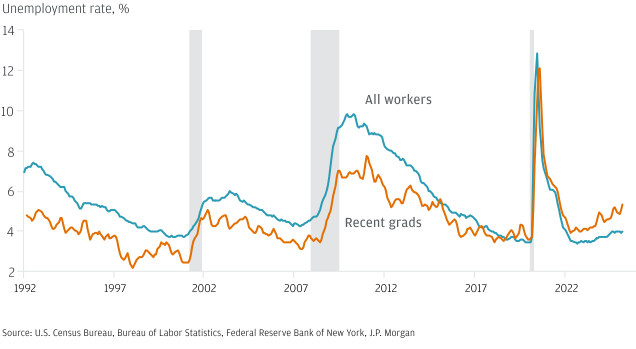
On Tuesday, the Bureau of Labor Statistics reported the US lost 105,000 jobs in October and added just 64,000 in November. Unemployment climbed to 4.6%, the highest level in more than four years.
A few trends stand out.
Construction is one of the few areas seeing real growth. The Bureau reported 28,000 new construction jobs, including 19,000 in nonresidential specialty trades. That surge lines up neatly with the race to build data centers, increasingly framed as “AI factories.”
While physical AI and robotics still aren’t ready to replace humans safely at scale, software AI is already doing exactly that to office work.
Research from MIT and Oak Ridge National Laboratory, using the Iceberg Index labor simulation, found that AI can already replace 11.7% of US jobs, representing roughly $1.2 trillion in wages. A Microsoft study published earlier this year reached a similar conclusion, identifying sales reps, technical writers, and data scientists as among the most exposed roles, while hands-on jobs like mechanics and maintenance workers remain relatively insulated.
As white-collar roles grow more precarious, some argue AI could revive blue-collar work. “AI is the one thing that could bring blue-collar jobs back at scale and close the labor shortage costing the US economy $1 trillion by 2030,” said Daniel Walsh, founder of Veroskills.
Nvidia CEO Jensen Huang has echoed that view, recently telling Joe Rogan he wants to help “re-industrialize the United States.” Not everyone needs a PhD or a Stanford degree, Huang argued. Manufacturing matters again.
The irony is hard to miss. AI was supposed to take on the dangerous, dirty, and repetitive work humans didn’t want to do. Instead, it’s quietly eating the cognitive jobs people spent decades training for. Companies like Salesforce, Accenture, and Klarna are already cutting thousands of white-collar roles after deciding AI is “good enough.”
If this is progress, it raises an uncomfortable question. Not what AI can do, but who it’s actually helping, and at whose expense.
Was this email forwarded to you?
That’s it for today and as always It would mean the world to us if you help us grow and share this newsletter with other operators.
Our mission is to help as many business operators as possible, and we would love for you to help us with that mission!