Scale & Strategy
together with
This is Scale & Strategy, the newsletter that makes you feel like you didn’t miss the memo.
Here’s what we’ve got for you today:
- Cursor x SpaceX is a bet that coding agents are the control layer
- OpenAI turns image generation into an actual work tool
Cursor x SpaceX is a bet that coding agents are the control layer
If there was any debate about where the AI race is heading, this deal clears it up. SpaceX just partnered with Cursor to build a top-tier coding agent alongside xAI, with an option to acquire the company for $60B if it works. If it doesn’t, they still pay $10B for the learnings.
That structure tells you everything. This isn’t a normal partnership. It’s a high-conviction swing with a fallback baked in.
Cursor needed this. A year ago it was valued at $10B and leading in AI coding. Since then, OpenAI and Anthropic made coding agents a core priority. Without guaranteed access to compute and frontier models, Cursor was getting squeezed from both sides.
This deal fixes that overnight.
On Cursor’s side:
- Access to SpaceX’s Colosus compute stack
- Direct line to xAI models instead of relying on competitors
- A real shot at staying in the top tier
On xAI’s side:
- Instant credibility in coding agents
- A faster path to competing with Claude Code and Codex
- A tighter loop between model development and real-world usage
The framing from SpaceX was blunt. The goal is “the world’s best coding and knowledge work AI.” Same target OpenAI and Anthropic are chasing.
That’s the real story here.
Coding agents aren’t just a feature category anymore. They’re the gateway to general-purpose agents. If you can reliably write, debug, and improve code, you’re not just helping developers. You’re building systems that can upgrade themselves.
xAI is behind, and this is a fast way to close the gap. Aggressive, slightly desperate, but directionally right.
Even if they don’t take the lead, this gives them a seat at the table.
And at this point, if you’re not competitive in coding agents, you’re not really in the race.
Finally, a creator marketing platform built on real performance data
Most teams buy UGC videos and hope they perform.
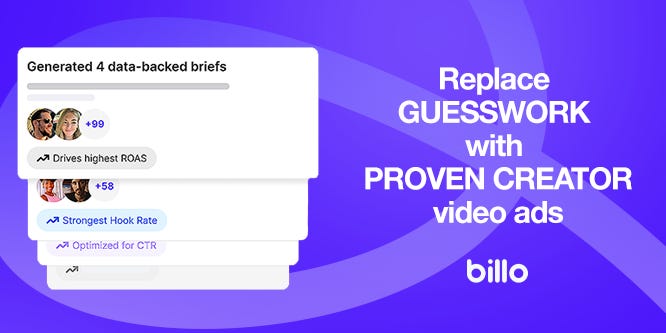
Billo offers a better approach. They turn creator videos into a measurable, scalable channel built on live performance data.
The fastest way to tap into it? Using the Billo IQ Brief Builder.
Here’s how it works:
- Generate concepts instantly. Turn any product page into four data-powered creator video concepts in seconds, each based on what’s performing right now and matched with creators by results. No more scrolling profiles or estimating engagement.
- Choose by results. See ROAS, CTR, and Hook Rate for eligible creators in your category before you hire.
- Test with no commitment. Get four briefs and see recommended creators with no payment required.
Every creative choice is backed by insights from 150,000+ video ads and $280M in tracked purchase value, so you can start with evidence, not guesswork.
Want to see how Billo works for your brand?
Use Billo IQ to generate your first four video briefs today.
OpenAI turns image generation into an actual work tool
Image models used to be for vibes. OpenAI’s latest release pushes them into utility.
ChatGPT Images 2.0 isn’t just generating pictures, it’s operating more like a visual system that can reason, check itself, and handle structured tasks. The focus is less “make something cool” and more “make something usable.”
The upgrades are meaningful:
- It handles complex instructions, layouts, and object placement with much tighter control
- Text rendering is finally reliable enough for real outputs like posters and infographics
- It can generate up to 8 variations in one pass while keeping consistency across characters and elements
- Stronger multilingual support, especially for non-Latin scripts
- Better style fidelity, down to lighting, texture, and composition
- More flexible aspect ratios, from ultra-wide to vertical
The biggest shift is the “thinking” layer. The model can browse, verify, and iterate before finalizing outputs. That turns it into more of a collaborator than a generator.
The standout use case is obvious once you see it in action: dense, text-heavy visuals that actually hold up. Posters, diagrams, educational materials. Stuff that used to require real design work now comes out in one pass.
That’s not an accident. OpenAI is explicitly pushing this into education and knowledge work, where visuals are useful but traditionally slow to produce.
It’s also shipping broadly. Available across ChatGPT and Codex, with more advanced capabilities gated behind paid tiers. The underlying model is exposed via API, so this will show up everywhere pretty quickly.
The context matters.
The previous generation is already producing over a billion images per week. So despite the narrative around “AI slop,” demand is massive. People aren’t pulling back, they’re just looking for outputs that are actually usable.
That’s the tension this release leans into. Better realism makes misuse easier, but it also raises the floor. When images stop looking obviously fake, they stop feeling disposable.
And once that happens, image generation stops being content spam and starts becoming infrastructure.
Was this email forwarded to you?
That’s it for today and as always It would mean the world to us if you help us grow and share this newsletter with other operators.
Our mission is to help as many business operators as possible, and we would love for you to help us with that mission!