Scale & Strategy
together with
This is Scale & Strategy, the daily pit stop that keeps your engine running.
Here’s what we’ve got for you today:
- Balaji Srinivasan tried to start a new country. The real world had other plans.
- The race to build an American answer to China's AI surge
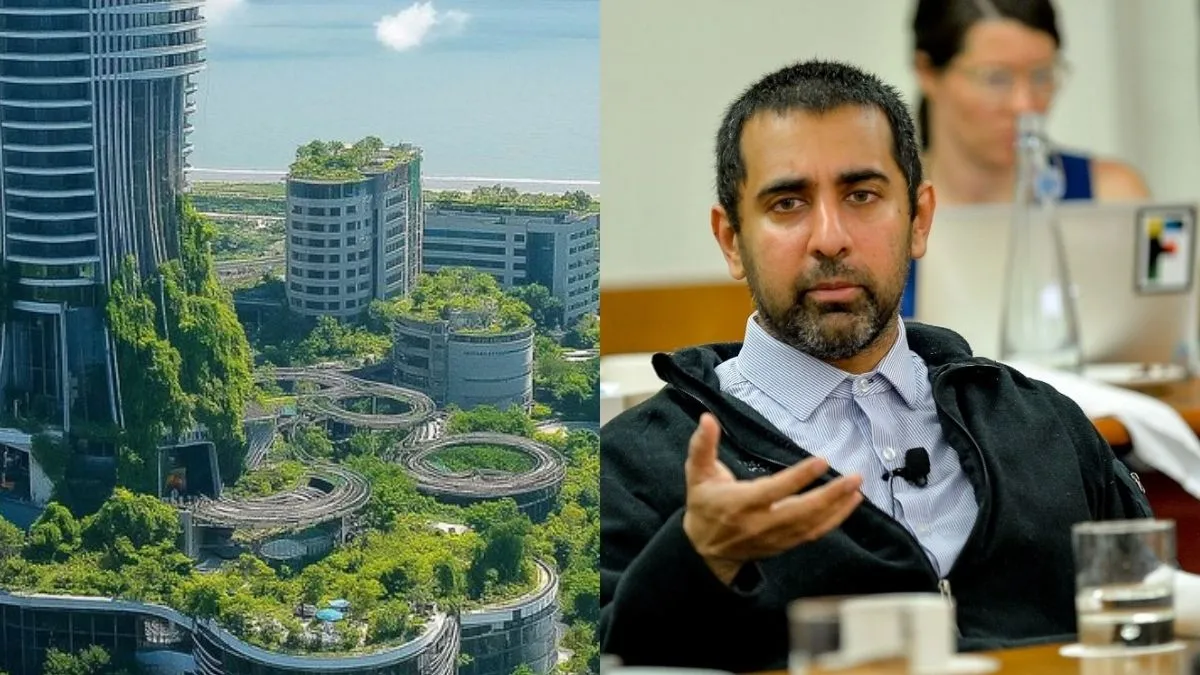
Balaji Srinivasan tried to start a new country. The real world had other plans.
For years, Balaji Srinivasan has argued that the internet will eventually produce a new kind of nation.
Not a nation built around geography.
A nation built around a shared set of beliefs.
He even wrote a book about it called The Network State.
Now he has spent the last two years trying to turn that theory into reality.
His experiment, called Network School, launched inside Forest City, a sprawling $100 billion Chinese-built development in Malaysia that became famous for turning into a ghost city. The idea was simple: gather ambitious founders, investors, builders, and families in one place, give them housing, coworking space, gyms, education, and community, then use that as the foundation for something much bigger.
Part startup accelerator.
Part intentional community.
Part prototype for a future digital nation.
The project attracted hundreds of participants from around the world. Residents worked on startups during the day, attended classes, lived together, and immersed themselves in a culture centered around technology, entrepreneurship, health optimization, and long-term thinking.
The pitch wasn't just "build a company."
It was "help build a new society."
That ambition immediately ran into a problem that every network-state advocate eventually encounters.
Existing states already exist.
Earlier this month, Malaysian authorities launched an investigation after allegations surfaced that Israeli citizens were living at the campus. Malaysia does not officially recognize Israel and imposes restrictions on Israeli visitors.
Authorities later said they had not found evidence of wrongdoing.
But shortly afterward, local officials ordered Network School to cease operations over licensing issues.
Within hours, Srinivasan announced plans to open a new campus in Kazakhstan.
In some ways, the episode perfectly captures both the promise and the challenge of the network-state movement.
Building an online community is relatively easy.
Building a startup is hard.
Building a city is harder.
Building something that starts to resemble a country requires navigating immigration systems, licensing requirements, property rights, politics, and governments that may not share your vision.
That hasn't stopped a growing group of tech founders and investors from trying.
Patri Friedman, grandson of economist Milton Friedman, has spent years backing startup-city projects. Investors including Peter Thiel, Marc Andreessen, and Srinivasan himself have supported efforts to create new jurisdictions with lighter regulation and greater autonomy. Projects such as Próspera in Honduras have attracted global attention while also generating fierce political opposition.
The underlying belief is that many institutions move too slowly, and that new communities should be able to experiment with different rules, governance models, and economic systems.
Critics see these efforts as billionaire fantasy projects.
Supporters see them as the next logical step after the internet connected people across borders.
What's difficult to argue with is that Srinivasan is one of the few people who actually tried.
Most people write books.
Most people start podcasts.
Most people tweet.
Balaji rented out part of a ghost city and attempted to build the first chapter of a new country.
Whether Network School succeeds in Kazakhstan or somewhere else, the larger question isn't going away.
The internet created global communities.
The next decade may reveal whether those communities eventually want territory of their own.
Why it matters: For most people, Network School looks like a strange experiment. For a growing corner of Silicon Valley, it's a test of a much bigger idea: whether online communities can evolve into real-world institutions that compete with traditional states. The answer will determine whether "network states" remain a thought experiment or become a new category of society.
AI agents are reshaping development, reportedly generating an average of 48% of code for surveyed organizations. But with that shift comes growing concern: 55% of engineering leaders surveyed are concerned about losing shared understanding of how their codebase evolves, and 39% are worried about shipping with confidence.
The issue is not that AI produces bad code. It is that each agent makes different decisions on frameworks, testing and patterns. Over time, this can create inconsistency that’s harder to review and maintain. Project-level rules provide a structured way to address this, encoding conventions and standards directly into workflows so AI-generated code remains aligned with how teams build and maintain software.
See how to help keep AI code consistent
The race to build an American answer to China's AI surge
For the first two years of the AI boom, the conversation revolved around OpenAI, Anthropic, and Google.
Now a different battle is emerging.
A growing number of startups are racing to build powerful American open-weight models as Chinese competitors like DeepSeek, Qwen, and Kimi rapidly close the gap with the leading U.S. labs.
The concern isn't just technological.
It's economic.
Over the past year, enterprises have increasingly embraced Chinese open-weight models because they're often dramatically cheaper to run. As AI bills ballooned, many companies started prioritizing cost over brand loyalty.
That shift has created an uncomfortable reality for Silicon Valley: some of the most widely adopted AI models in the world are increasingly coming from China.
A handful of U.S. startups are trying to change that.
One of them is Arcee AI, a relatively small startup that recently trained an open-weight model using a fraction of the resources available to OpenAI, Anthropic, or Google. The company says it completed a major training run in just 33 days and built a model that users can download, customize, and run themselves.
The broader goal is to create an American alternative to China's growing open-model ecosystem.
"There is a vast degree of demand for an American company producing the most capable open-source artificial intelligence," said Poolside co-founder Jason Warner.
The challenge isn't demand.
It's funding.
Despite growing concern in both Silicon Valley and Washington about China's progress, many investors remain reluctant to back open-weight AI companies.
Part of the hesitation comes down to business models. If the product is freely available, investors naturally ask how the company plans to make money.
The other issue is more awkward.
Many venture firms are already heavily invested in OpenAI, Anthropic, and other closed-model companies. Funding open-weight competitors could potentially undermine those bets.
According to Arcee CEO Mark McQuade, nearly every major venture firm passed on the company.
"Every tier-one VC pretty much said no," he said.
The result is a strange dynamic where some of the loudest public supporters of American AI competitiveness have been reluctant to fund the startups actually building alternatives.
Meanwhile, China keeps moving.
What started as a U.S. advantage with Meta's Llama ecosystem has gradually evolved into a far more competitive landscape. Open-weight models from Chinese labs are becoming increasingly capable while continuing to pressure pricing across the industry.
That pressure is already reshaping the market.
OpenAI has cut prices. Anthropic has focused heavily on efficiency improvements. Nearly every major model launch now includes some discussion of token costs and inference economics.
The industry is realizing that intelligence alone isn't enough.
The cheapest capable model often wins.
That's why companies like Nvidia have emerged as some of the strongest supporters of the open-weight ecosystem. The chip giant has backed multiple open-model startups and helped launch initiatives designed to strengthen the broader open-source AI community.
For many in the industry, this isn't simply about open versus closed models.
It's about whether the United States maintains leadership in a category that China increasingly appears determined to dominate.
The irony is that some of the startups leading that fight are doing it with relatively tiny teams and modest budgets compared to the giants they're competing against.
Arcee has roughly 30 employees and has raised about $50 million to date.
OpenAI, Anthropic, and xAI collectively raised hundreds of billions of dollars in capital over the same period.
Yet the gap may not be as large as the funding numbers suggest.
The cost of training models is falling. Open-source infrastructure continues to improve. And every new generation of hardware makes it easier for smaller players to compete.
The question is no longer whether America can build open-weight AI.
The question is whether investors will support it before China captures too much of the market.
Why it matters: The next phase of the AI race may not be decided by who builds the smartest model. It may be decided by who builds the cheapest, most accessible one. Right now, China has momentum. A growing group of American startups is trying to make sure it doesn't keep it.
Was this email forwarded to you?
That’s it for today and as always It would mean the world to us if you help us grow and share this newsletter with other operators.
Our mission is to help as many business operators as possible, and we would love for you to help us with that mission!